- Today
Sclerotherapy for Aesthetic Beginners
- Emma Kelliher
- Aesthetics
Published: 18th November 2026
Author: Emma Kelliher, RN, NIP | Board Member, British Association of Sclerotherapists
TL;DR: Key Takeaways
Spot the ideal cosmetic patient. You can proceed with a formal consultation if a patient presents with isolated spider or reticular veins, no leg swelling, no varicose veins, no skin changes and no history of venous disease.
Use a Duplex scan as your safety net. If a patient shows red flags like aching, oedema, varicose veins, skin changes or a past DVT, they need a Duplex scan and a vascular referral before any cosmetic treatment.
Know your scope and stay in your lane. Your role as an aesthetic practitioner is not to diagnose underlying venous disease, but to safely treat straightforward cosmetic cases and confidently refer complex ones.
When to Treat, When to Refer and Why Staying in Your Lane Matters
A simple plan; This article is specifically aimed at aesthetic practitioners who are introducing micro-sclerotherapy as an additional service within an existing medical aesthetics clinic and are treating patients presenting with cosmetic thread and spider veins to the legs.
It is about becoming confident at recognising the straightforward cosmetic patient who may be suitable for micro-sclerotherapy, while equally recognising the patient whose presentation falls outside that remit and requires further vascular assessment.
In other words: know your scope, recognise your limits and have a clear referral pathway.
An important principle for anyone treating leg telangiectasia and reticular veins: although many patients present with a cosmetic concern, appropriate assessment is essential to identify those who may have underlying venous disease and require referral.
For practitioners adding micro-sclerotherapy to an aesthetics practice, we can make the assessment process simple.
The uncomplicated cosmetic patient presents; no leg swelling, no varicose veins, no concerning skin changes and no relevant history suggesting underlying venous disease. If this patient presents you can then take the time to conduct a formal consultation and go through your normal process including taking a more in-depth medical history to rule out contraindications to the treatment itself.
When the patient moves outside your lane there is no need to take the process any further.
Symptoms, visible or palpable varicose veins, oedema, venous skin changes, previous DVT or venous intervention, treatment-resistant telangiectasia or other features suggesting underlying venous disease should make you stop and consider whether further vascular assessment is required.
Simple Strategy to safety net this decision making process. If they fall into any of the criteria requiring a Duplex Scan it’s likely your treatment would be destined for failure.
If they need a duplex, they need to be referred. Take a look at the handy practical frame work and table below created by Dr Haroun Gajraj of the Veincare Academy.
Remember examine your patient;
· Standing for 3 to 5 minutes
· In good lightening
· The legs exposed from the groin to the feet
· Look at the entire leg not just the veins that concern the patient.
DUPLEX BEFORE MICROSCLEROTHERAPY
When do you actually need a duplex scan?
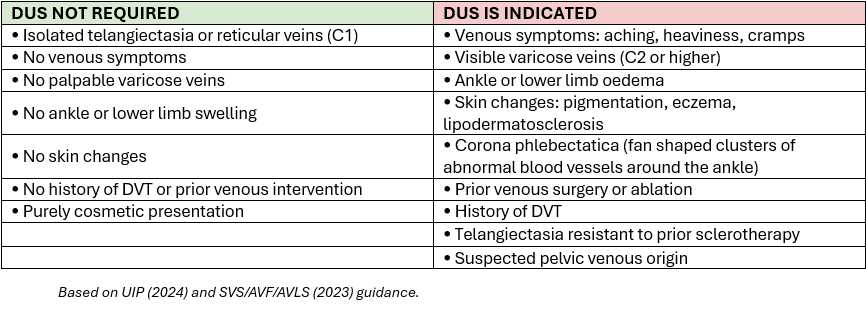
From Duplex ultrasound scanning before microsclerotherapy for leg telangiectasia: Mandatory versus selective use: A critical evidence review,” by H. Gajraj & R. Oliver, in press, Journal of Sclerotherapy. Copyright © 2026 by Journal of Sclerotherapy.
Remember the key rule throughout this article is:
You are not the person who diagnoses and manages the underlying venous disease. You need to be the practitioner who recognises when a cosmetic presentation may be more than cosmetic. If you do not have a referral pathway set up do not panic just suggest to the patient that there may be under lying drivers behind what they are presenting with and if they are motivated to get a satisfactory result they need to seek further assessment and possible treatment first.
The take-home message;
If you’re adding micro-sclerotherapy to an existing aesthetics practice, your role is to become excellent at treating appropriately selected cosmetic patients and equally good at recognising those you shouldn’t treat.
References
Gajraj, H., & Oliver, R. (in press). Duplex ultrasound scanning before microsclerotherapy for leg telangiectasia: Mandatory versus selective use: A critical evidence review. Journal of Sclerotherapy.
About the Author

Emma Kelliher, RN, NIP
Emma Kelliher is the founder and Clinical Director of EK Clinics®, well-established CQC-registered medical aesthetic clinics based in Oxfordshire and Northamptonshire. An Aesthetic Nurse Prescriber with over 20 years of full-time clinical experience, she began her aesthetic career on Harley Street and served for over a decade as CQC Registered Manager for one of the UK’s largest non-surgical cosmetic providers.